
Jump to:
The Android operating system powers a significant share of business mobile devices. These are no longer just smartphones and tablets used by office workers; they are also highly specialized equipment: warehouse scanners, industrial terminals, self-service kiosks, and devices dedicated to uniformed services.
Although we commonly call them “Androids,” many are actually based on the Android Open Source Project (AOSP), a system without Google services. This absence poses significant management challenges and requires a non-standard approach from Mobile Device Management software manufacturers.
The Proget team addressed this issue and developed a complete scenario for supporting mobile devices with AOSP.
This unique solution allows you to maintain almost the same level of functionality and convenience as with devices running “classic” Android and Google services. This enables organizations to centrally manage and consistently protect the parts of their mobile fleet that typically remain outside IT administrators’ control.
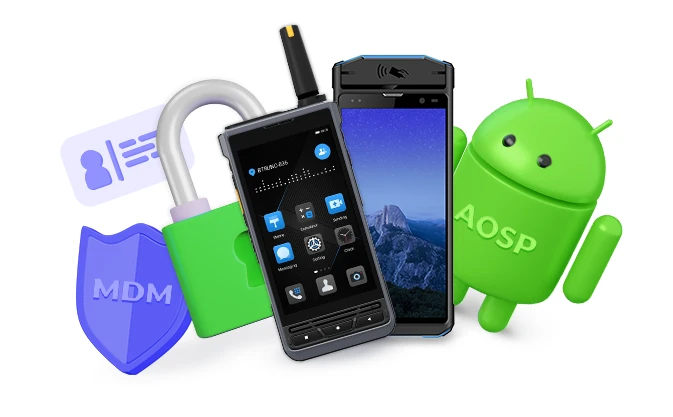
What is AOSP, and in what contexts is it used?
Users of Android phones and tablets know that this system can look and behave differently depending on the device’s brand. For example, Samsung devices feature the manufacturer’s One UI overlay with additional options, while Xiaomi uses MIUI with its own interface and applications.
The name “Android” actually covers a variety of implementations. Their common foundation is AOSP – an open-source version of the system that hardware manufacturers and enthusiasts from the Android community can freely modify.
For consumer devices, modifications include adding proprietary interfaces, pre-installed default applications, and the Google Mobile Services (GMS) package, followed by certification that enables the legal use of the entire ecosystem.
In industries such as logistics, manufacturing, retail, and public institutions, the situation is different. These sectors often rely on specialized hardware with a “clean” or heavily modified AOSP, which allows for close alignment of the operating system and device characteristics with business requirements and facilitates integration with dedicated software.

GMS services are unnecessary here and can even be troublesome. They introduce additional components and mechanisms that depend on Google and can send data to external servers, which can be problematic from a compliance perspective for regulated industries with restrictive security policies. In addition, automatic GMS updates can introduce changes to APIs, system services, or device settings. In practice, this makes it difficult to maintain a predictable, consistent operating environment, which is why AOSP is preferred in such scenarios.
MDM support for Android AOSP devices – why is it important?
The aforementioned flexibility of AOSP is a significant advantage, but it also poses challenges for remote management. Most MDM solutions available on the market assume the presence of Google mechanisms on the device, and their absence causes many problems in this context. On AOSP devices, neither the latest management model based on the Android Management API nor modern device provisioning methods (e.g., automatic assignment to an organization via Zero Touch, NFC, or QR code) are available.
Difficulties arise not only when registering devices, but also when installing and configuring applications without the managed Play Store, as well as when configuring managed applications. The lack of Google services also means no remote communication with the device (FCM), location support, and security features such as Play Protect. Above all, however, AOSP-based devices are not certified by Google, which significantly limits their compatibility with most MDM solutions and the support available from their providers.

Supporting Android AOSP via MDM requires, among other things, the use of manufacturer-specific integrations and the development of proprietary hardware management mechanisms. The high complexity of implementing such solutions means that few MDM providers choose to do so.
As a result, even technologically advanced equipment that lacks Google certification can give an organization an unpleasant surprise – it works efficiently but is “invisible” and “unmanageable” to a significant portion of MDM tools.
This situation forces IT departments to manually manage devices, which quickly becomes costly, inefficient, and a security risk as device numbers grow.
Therefore, choosing an MDM that supports AOSP gives an organization a real advantage by enabling:
- managing a much wider range of devices – not just certified and “enterprise-ready” ones,
- tailoring hardware configurations to actual tasks and business processes,
- ensuring security and control even in non-standard deployments.
As a result, AOSP ceases to be a problematic “exception” in the mobile fleet and becomes an integral part of the IT infrastructure, managed on similar terms as typical Android devices. For companies, this means measurable operational and financial benefits – while maintaining security and flexibility in terms of adapting equipment to specific needs.

Summary
AOSP is an open-source version of Android that plays an important role in the world of business devices. The lack of Google services makes it a natural choice for specialized equipment while also setting a high bar for MDM-class systems.
With Proget’s Android AOSP support, each implementation can be tailored to your business needs. We support and secure not only smartphones and tablets, but also other devices beyond the reach of most remote management solutions.
If your organization uses AOSP devices or plans to implement them, please contact us. We will show you how to manage your work environment effectively and securely.
Get in touch for a consultation today.


Author: Agnieszka Pierlak
Marketing specialist with experience in the IT industry. Interested in issues related to cybersecurity and internal security. Privately, a lover of good literature, Asian cuisine and mountain hiking.