
Jump to:
Corporate smartphones, tablets and rugged devices are an integral part of a company’s IT infrastructure. In many organizations, however, information about them resides in the MDM system, while other assets, service requests and IT processes are handled in separate tools.
Although each of these systems performs its role well, the lack of a connection between them creates a “mobile blind spot”, which can hinder a rapid response to security and hardware issues and force administrators to look for information across multiple sources. That is why a growing number of organizations recognize the need to monitor mobile devices on the same terms as other IT assets.
This is made possible by the integration of Proget MDM with OXARI ITSM, developed by the team at Infonet Projekt SA – the developer of the OXARI platform, with which we have established technology cooperation. Thanks to the integration, information about mobile devices enrolled in Proget MDM can be used in the broader context of IT management.
Two solutions, one goal
The integration combines two specialized technologies: each retains its own role, while their capabilities complement each other.
Proget MDM is a Polish solution that enables advanced mobile device management and security scenarios. It allows organizations to centrally configure smartphones, tablets and rugged devices, control the applications installed on them, and enforce security policies.
OXARI ITSM is a Polish platform that brings the key areas of IT management together in a single environment – from request and incident handling in the Service Desk, through IT asset management (ITAM) and the configuration management database (CMDB), to process automation.
How does the integration work?
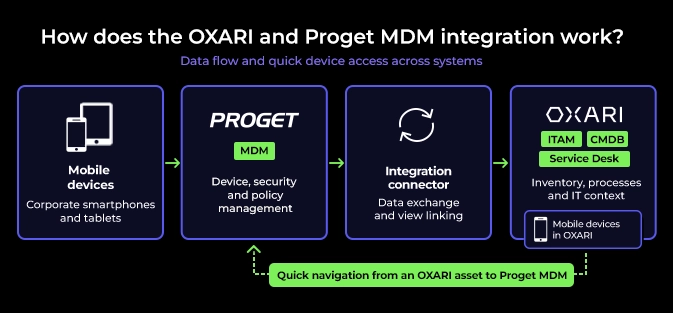
Corporate mobile devices are enrolled and managed in the Proget console. A dedicated connector built by Infonet Projekt automatically transfers data about them from Proget MDM to OXARI. It also lets you define which information is synchronized and how it maps to fields in OXARI (attribute mapping). As a result, smartphones and tablets appear in the ITAM inventory and the CMDB alongside computers, servers and other hardware. This information can also be used when handling requests in the Service Desk.
What do organizations using both solutions gain?
Both administrators and the company as a whole will see tangible benefits:
- A consistent view of the organization’s assets – the IT department has more complete knowledge of the hardware in the company’s infrastructure and can use this information when planning and accounting for assets.
- Less manual work – automatic data updates reduce time-consuming, repetitive tasks and minimize the risk of errors and discrepancies in the inventory.
- Faster handling of requests related to the mobile fleet – the IT team sees a Service Desk request together with information about the specific device. If they need more data or want to perform an administrative action, they can open that device’s view in the Proget console directly from the asset in OXARI, without having to search for it again.
- Greater control over the environment and data – Proget MDM and OXARI ITSM can also be deployed on-premise. This allows companies and institutions with the highest security requirements to retain control over their own IT environment and over where information is stored and processed.
- Support for regulatory compliance – NIS2 directive emphasizes up-to-date knowledge of all devices with access to company data and a prompt response to incidents. The integration can support organizations in these areas, although on its own it does not guarantee regulatory compliance; it remains one element of a broader system of processes and safeguards.
An ecosystem built on Polish technologies
Companies that are changing their tools or are in the process of selecting them can build a consistent IT management environment from the outset, based on two systems developed in Poland, in Bielsko-Biała. The integration with OXARI is part of Proget MDM’s development strategy as a solution that is becoming a natural part of IT environments built on multiple interoperating tools. It also shows that integrated Polish software can be a viable alternative to global ecosystems.

Author: Agnieszka Pierlak
Marketing specialist with experience in the IT industry. Interested in issues related to cybersecurity and internal security. Privately, a lover of good literature, Asian cuisine and mountain hiking.